
Blog
Relax with Reishi

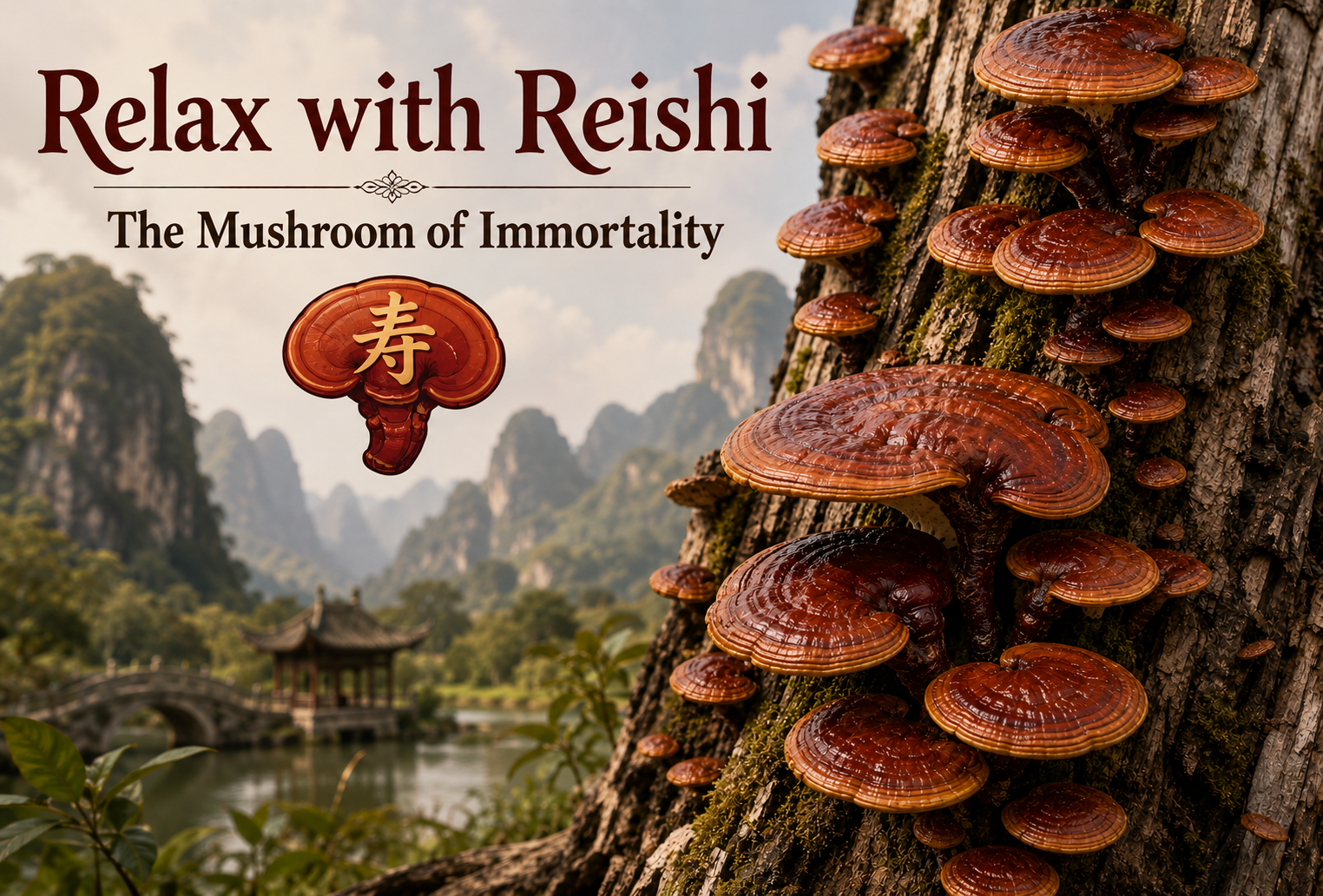
Functional Mushrooms are Bringing FUN-gi
Functional mushrooms are staking their claim in the wellness realm, and with more people turning to nature for help on their wellness journey, more members of the Fungi Kingdom are being sampled and incorporated into daily routines.
And Reishi mushrooms are one of the best functional mushrooms on the market!
Reishi: The Mushroom of Immortality
Revered for thousands of years, Reishi is a significant mushroom hailing from Ancient China. Growing on hardwood trees such as oak and maple, this wild-growing mushroom was collected by hand, and finding one was quite exciting! They were rare, and coming across them was considered a sign of good fortune. The earliest written records of the mushroom were located in the Shennong Ben Cao Jing, one of China’s oldest herbal texts. Reishi was categorized among the highest class of herbs – treasured in traditional herbal practices. The text describe it as a rare gift from nature that was associated with:
🟡 Longevity
⚖️ Balance
🟢 Vitality
☮️ Inner Peace
💰 Good Fortune
🙏 Wisdom and Spiritual Growth
Want a closer look at what wonders Reishi hold? Buckle up. It’s about to get a little scientific. The key compounds found within Reishi are:
Triterpenes
These compounds help protect organisms from environmental stressors. With research ongoing, triterpenes are being studied for their potential roles in relaxation and stress response, assisting the body’s inflammatory process, and immune system support.
Beta-Glucans
This type of polysaccharide is often studied for its interaction with the immune system. They’re described as immunomodulatory – epic, right? This means they may support healthy immune function and communication between immune cells.
Polysaccharides
Complex carbohydrates that contribute to many of the researched areas of the mushroom and what they are marketed for such as immune support, help with antioxidant activity, healthy aging, and gut health.
⭐ It’s important to note functional mushrooms are still being heavily researched. These statements have not been evaluated by the FDA. We can only present findings of personal experiences from customers and other users.
Reishi mushroom products are not intended to diagnose, treat, cure, or prevent any disease.
Traditional Times: Prepping Reishi
Reishi does not host the same flavor profiles as its delicious shiitake or portobello cousins. They’re extremely bitter and almost woody-tasting.
~ Decoction
Rather than consuming them raw, people would use the traditional preparation method of decoction. This involves simmering the mushroom in water for an extended period of time (anywhere from 1 to 3 hours). Ancient herbalists would slice the dried Reishi into thin pieces, add them to a pot of water, simmer, strain, and drink the resulting liquid.
~ Powdered Reishi
Some dried Reishi was ground into a fine powder using stone mills. It could then be mixed into hot water, combined with other botanicals (such as Ginseng, Goji Berry, and Astragalus), or added to soups or broths.
~ Medicinal Wines
In some regions, Reishi was infused into rice wine or other alcoholic preparations. The mushroom was first dried, added to a vessel containing alcohol, and left to steep in a cool location for weeks or months.
Modern Practice
While Reishi can still be picked from dying hardwoods in the wild, growing the crop and cultivating it is the primary method to get the mushrooms on the market. Dedicated mushroom farms have their larger scale methods of farms tend to hardwood logs, drilling holes, introducing Reishi spawn, allowing the fungus to colonize the wood, and then keeping a close watch of the humidity and temperature.
Again, with their bitter flavor and woody texture, the mushroom is not eaten whole or cooked with.
One of the most popular methods of Reishi usage is via capsules and tablets. These use standardized Reishi extract and are frequently labeled as ‘Reishi for stress’ and ‘Reishi for immune support.’
Another popular option is Reishi in powder form. This can be blended in with smoothies, coffee, or protein shakes. It’s often combined with other functional mushrooms like Lion’s Mane and Cordyceps. Liquid extracts and tinctures also supply a solid mixing option for Reishi usage.
Functional beverages is a huge modern category including mushroom coffees, herbal teas and “calming blends” ~ Ready-to-drink wellness beverages are here for those looking for a more simple option! It’s Reishi for relaxation with no prep work!
And of course, Reishi has their place in the Gummies realm. These are generally lower dose than tinctures and capsules – but ideal for on-the-go lifestyles who like a pop of fruit with their shroomies.
Modern marketing for Reishi focuses on supportive wellness. Common phrases you may come across are:
“Supports relaxation”
“Helps you unwind”
“Evening calm” – Reishi before bed can assist you with easing into the the tired spell
“Supports restful sleep” – 🛌 Reishi and sleep go hand in hand
“Helps maintain balance (homeostasis)
“Immune Support”
“Year-round wellness”
Functional Mushroom Comparison
In addition to Reishi, Lion’s Mane, Chaga, Cordyceps, and Turkey Tail are functional mushrooms that are utilized for their unique properties. Reishi, Cordyceps, and Chaga, and Lion’s Mane are adaptogenic mushrooms. Adaptogens are believed to help the body adapt to physical, mental, and environmental stressors while supporting overall balance (homeostasis).
Reishi Mushroom vs Lion’s Mane
⚪️ Lion’s Mane is a shaggy white mushroom (with a resemblance to the large cat’s hairstyle) that grows in temperate forests throughout North America, Europe, and Asia. They often emerge after periods of rain and high humidity.
This easy-to-identity shroom is known for its association with brain health and mental performance, recommended to anyone looking to support focus and cognitive function – great for professionals or students requiring concentration.
⭐️ Lion’s Mane is also being studied for its unique compounds – hericenones and erinacines – which hold a potential role in nerve growth factor (NGF), a protein involved in the growth and maintenance of nerve cells.
🟠 Reishi is best known for supporting relaxation, creating a calming evening routine, or managing stress on the day-to-day. This mushroom is better taken later in the day after finishing the last of the to-do list.
Reishi vs Chaga
🔵 Chaga grows primarily on birch trees and is known for its exceptionally high antioxidant content. It is immune-focused and praised for general wellness support.
🟠 Reishi is promoted more for its relaxation and its adaptogenic reputation.
Reishi vs Cordyceps
🔴 Cordyceps fungi thrive in high altitude regions of the Himalayan plateau (Tibet, Nepal, and Bhutan are a few of the big ones).
This one has a bit of a freaky growth cycle. Cordyceps is a parasitic fungus that overtakes caterpillars or insect larvae and consumes its host from the inside. In time, a thin finger-like fruiting body grows out from the insect and emerges from the soil.)
The result is a fungi that is marketed for energy support, physical performance, and pre-workout formulas. Cordyceps is viewed as the “get going” mushroom.
🟠 Reishi is frequently promoted for its calming properties and balance and recovery mindset. Reishi is viewed as the “wind-down” mushroom. Better to take before bed than before the lift session.
Reishi vs Turkey Tail
🟡 Turkey Tail mushrooms are one of the most researched medicinal mushrooms. Also growing on dead hardwood trees, these are known as saprophytic fungi. This means it feeds on dead organic matter rather than the living oaks and maples. It’s also cosmopolitan – sprouting across moist, wooded areas in 6 of the 7 continents – North America, Europe, Asia, Australia, and parts of South America. None in Antarctica, of course!
These mushrooms appeal to customers focusing on immune system support. They also contain a rich source of polysaccharides.
Curious about its name? Picture a turkey and you’re nearly there! Turkey tail resembles a turkey’s tail feathers – thin, fan-shaped brackets. They grow in overlapping clusters on the wood in brown, tan, orange, and sometimes blue-gray color bands.
🟠 Reishi mushroom benefits: calmness, balance, stress adaptation. Reishi roughly translates to “spiritual mushroom” from its Japanese origin. It reflects just how rare and revered it was in ancient times.
As far as physical appeal, Reishi grows as hard, shelf-like fan-shaped bracket fungus. Instead of a soft cap and stem like many common mushrooms, it forms a woody, semicircular “conk.” It has a glossy, varnished surface and comes in reddish-brown to deep orange colors (sometimes with yellow or black tones).
It really doesn’t look edible at all. 😅
SHOP Zion Herbals for Your Functional Mushroom Needs
Reishi
BREZ Dream
Lion’s Mane
BREZ Flow
Magic Dose Euphoric Seltzers
Golden Grove Sparkling Tonics
Cordyceps
BREZ Elevate