Blog
Fiji: Their Traditional Kava Ceremony

The Fijian Atmosphere
Let’s set the scene.
Most of us are aware of Fiji’s beautiful tropical setting that features warm weather, sandy beaches, and luscious palm trees. 🏝️☀️ Lovely!
The island also supplies rolling grassy hills, forested mountains in the distance, shallow rivers, sugarcane fields, and traditionally *thatched Fijian houses/huts known as bures (pronounced BOO-rays). These homes use timber or bamboo for framing and woven reeds or split bamboo for walls. The roofs are constructed with Pandanus leaves, palm leaves or grasses.
* thatched = covered/constructed with tightly layered dried plant materials
The Fijian village community hall is essentially the village’s shared gathering and meeting place, sometimes called a meeting or vale ni bose, which approximately translates to “house of meetings.” While there is no strict single design used throughout the country, a traditional-looking Fijian hall might have:
🔴 A large, rectangular open interior
🟡 Thatched roofing or corrugated metal (this depends on the village)
🟣 Woven pandanus mats covering most of the floor
🟢 Timber, woven-reed, or concrete walls
It functions almost like a combination of a town hall, community center, and ceremonial space.
Including…the Fiji Kava ceremony.
Fijian Kava Traditions : What Happens at a Kava Ceremony
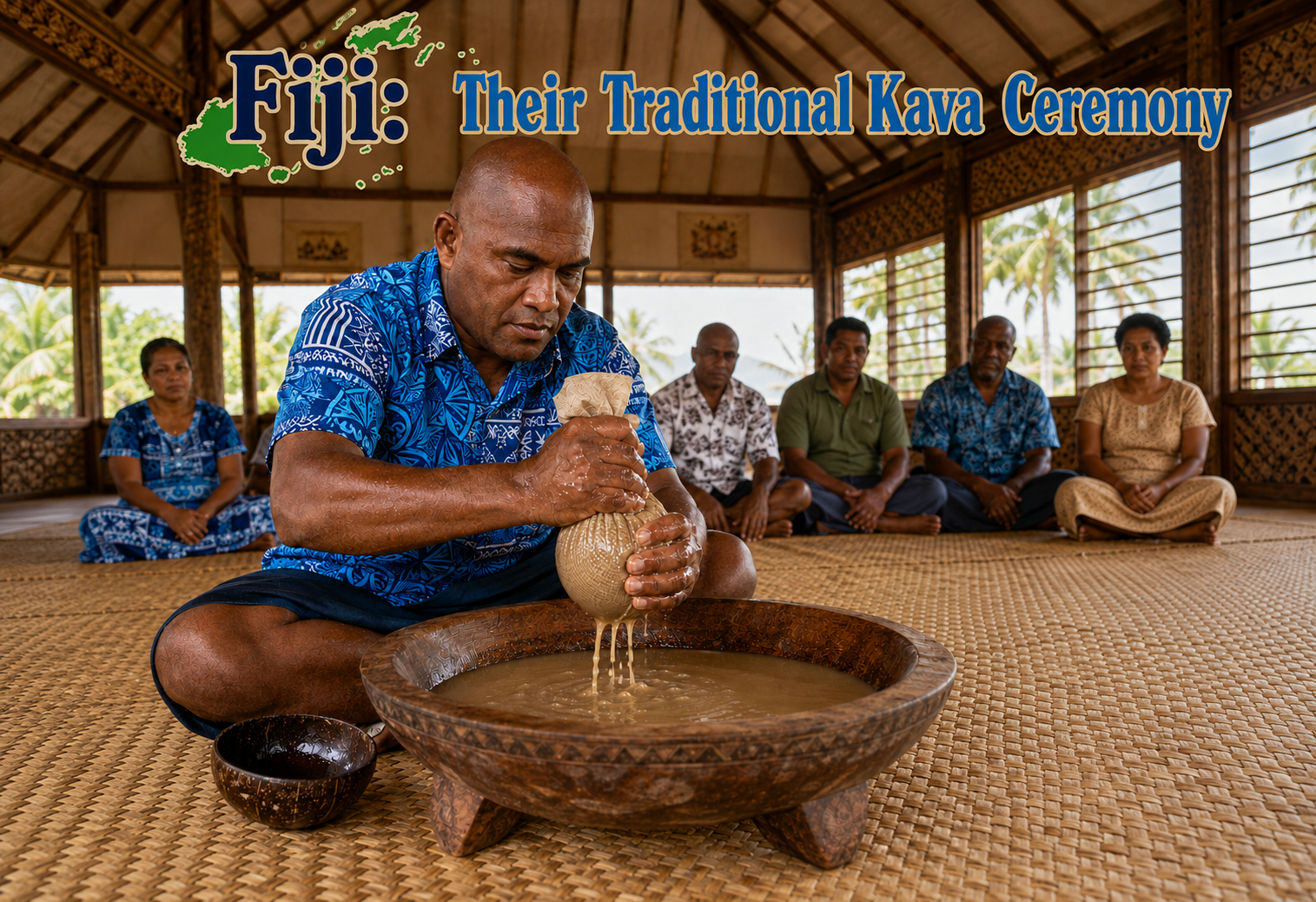
The community hall room is generally kept open so everyone can sit on the floor. The chief, elders, spokespersons, and all honored guests have designated seats while other participants sit behind or around them on the woven mats.
Kava ceremony etiquette:
Dress modestly. Shoulders and knees should be covered. Some guests are presented with a sulu (a lightweight wraparound fabric garment worn around the waist) that can be worn over existing clothing by both men and women. Hats and sunglasses should be removed while shoes are left at the entrance.
Looking to capture the moment? Guests are advised to ask permission before taking photographs 📸 (especially during the formal ceremony).
Do not touch anyone’s head. This is considered inappropriate in Fijian village customs. Guests are also advised to remain seated in a cross-legged position during the ceremony and to not stretch their legs towards the chief or elders.
How is Kava served in Fiji?
Kava (known as Yaqona in Fiji) is traditionally presented as a gift in dried or powdered form from the visiting group. This offering is known as an isevusevu or sevusevu. It’s then presented to the chief by a spokesperson, while requesting permission for the group to enter the community.
Here is a rundown of the traditional Kava preparation method:
The Kava powder is placed into a porous cloth and strained into the large communal wooden bowl (Tanoa Kava bowl) with cool or room temperature water. The cloth acts almost like a large tea bag, though it is kneaded rather than being left to steep. More water can be added depending on the amount of Kava and desired strength. The finished drink has an opaque, muddy or earthy brown appearance with a flavor profile of earthy, peppery, and woody.
Serving from the Tanoa, the cup bearer then fills the bilo Kava cup. What’s a bilo you ask? This cup is generally made from half a polished coconut shell. 🥥
The first serving is presented according to ceremonial rank – usually the chief or principal guest – before the cup continues around the gathering.
Why Do People Clap During a Kava Ceremony?
Before accepting the bilo, guests clap once with cupped hands 🙏, receive the cup respectfully with both hands. What do people say before drinking Kava? They shout “Bula!” to acknowledge the host. “Bula” translates to “life” and it’s comparable to saying “cheers!” before taking a drink in the States. This initial clap is done as a formal sign of respect. Take one continuous motion sip, then return the bilo cup to the cupbearer.
Finally, clap three times with cupped hands and say “Vinaka”, meaning “thank you.” This signals that the serving has been completed and expresses appreciation.
Group clapping usually occurs at the ceremony’s major transitions and after important participants finish drinking. For example, the group may clap when the yaqona is ready after the mixer announces the liquid prepped and complete.
Group clapping also generally occurs after the chief has taken their drink and after the cup has been emptied in which the Kava preparer may call “Maca!” meaning “empty” or “finished.”
A final round of clapping may acknowledge that the bowl – or formal portion of the ceremony – is complete.
–Vocabulary Recap–
Yaqona – Fijian name for “Kava”
Iseusevu / Sevusevu – traditional Fijian welcoming ceremony and presentation of gifts
Tanoa – traditional wooden bowl to mix and serve Kava
Bilo – traditional drinking vessel made from half a coconut shell
Bula! – Fijian word that translates to “life”. Used like “cheers!” when sharing traditional Kava
Vinaka! – translates to “thank you!” in Fiji
Maca! – Fijian for “empty!” or “finished!”
Experience the Tradition at Home
🌴 Kavaly Premium Micronized Kava Powder – Sourced from the Vanuatu Islands. Ready-to-use, pure, potent Kava in its base form. Simply add water or a beverage of your choice.
Available in 4 oz and 8 oz bags
Disclaimer
⭐ Do not combine Kava with alcohol or other sedating substances, and do not drive or operate machinery after consuming it. Consult a qualified healthcare professional before using Kava if you take medication, have a medical or liver condition, are pregnant or breastfeeding.
For adults 21+ only.
Kava has not been approved by the FDA to diagnose, treat, cure or prevent any disease.